

Our Technical Director, Jon Vernon reflects on how adopting an effective and consistent systems-based asset management approach can bring benefits to any organisation.
A big part of my career has been spent implementing and supporting asset management systems within the rail industry, and it’s still a sector which is a source of a lot of our business here at Arcspeed, and which we are proud to be able to support.
By its nature, rail is traditionally a heavily “asset-centric” industry, which is no surprise given its role in ensuring critical national infrastructure is maintained safely and effectively. Good quality data on assets and their condition in this context is absolutely vital to support effective maintenance operations and to inform future strategy and investment.
The products and services which we provide at Arcspeed are shaped by our knowledge and experience in this sector, as is our awareness of the huge value which good quality asset data can bring to organisations of all types, and we genuinely believe that improved asset management can bring significant benefits to any organisation.
One of the most enjoyable, interesting and rewarding aspects of my role at Arcspeed now is having the opportunity to bring an asset management system capability to a much wider market, particularly in supporting sectors and organisations who wish to take a more asset-centred approach to their decision-making but who have perhaps not previously had access to the appropriate tools, processes or knowledge to support good asset management practice due to prohibitive cost or lack of in-house technical resources.
This is perhaps best exemplified by the work we do in supporting the UK National Parks family. Over the last 8 years we’ve had the pleasure of working with four UK national parks where our asset management platform is used to support a wide range of functions from rights of way surveys to vehicle and marine fleet management and facilities and property management inspections. It’s a sector which is highly diverse and with its own unique set of challenges but also a surprising level of overlap with other clients in terms of statutory and safety critical maintenance requirements, the interface with the general public and the management of linear infrastructure.
What Do We Mean by Asset Management?
When we engage with a new client one of the first and most fundamental questions we need to ask is “what is an asset?”
It sounds like a very straight-forward question, but the reality is that the answer to this is different for every organisation we work with.
Put simply, an asset is literally anything which has value or potential value to your organisation. This could be tangible infrastructure, buildings, plant or tools – but it could equally be a landscape or natural features for which you have a duty of care or legal or responsibility.
The effective management of data relating to the condition and maintenance of an organisation’s assets is absolutely key to its effective decision-making and planning, and it’s this recognition that reliable and robust data is an asset in itself that is perhaps one of the most important foundations of good asset management.
What Does Good Asset Management Look Like?
To answer this question, it’s perhaps most useful to describe the typical characteristics of organisations who are at the very start of their asset management journey.
Organisations like this will typically be in “reactive mode” – teams may well have all the required knowledge and skills but are working locally and in isolation to remedy faults and issues with assets as they happen. There is little or no central visibility of what is going on or the overall condition of the organisation’s asset estate until something goes wrong.
Whilst this doesn’t necessarily mean that assets are not being managed or maintained, there is very little available bandwidth for strategic planning at this stage, and the organisation is very much in firefighting mode. It may also be exposing itself to a significant amount of unnecessary risk and cost due to people operating in silos and a lack of knowledge of the overall asset state.
The Institute of Asset Management defines good asset management as follows:
“Maximising the long-term value of assets by aligning them to the objectives and purposes of the organisation.”
Whilst systems and technology are a key part of achieving this, it’s also fundamentally about people and processes and – perhaps most importantly – fostering and promoting a culture which recognises the value of good asset management principles.
This requires both a “bottom up” and “top down” approach – ensuring good stakeholder engagement which leverages and empowers the skills and knowledge of subject matter experts on the ground whilst also ensuring visible and consistent leadership and effective communication on the organisation’s asset management aims and objectives.
An organisation that’s committed to improving asset management will, above all, recognise that good decisions are based on good data, which has clear ownership, and that information is the most important asset they own.
The characteristics and benefits of good asset management can perhaps be summarised as follows:
- Improved knowledge of asset condition means better decisions can be made on future investment
- Increased focus on pre-emptive rather than reactive maintenance / faults saves time, money and effort, and reduces the operational impact of incidents
- Reduced failures / incidents leads to reduced risk and cost
- Less time firefighting means more time is available for long term strategic planning and more space for innovation
- Better quality and more timely data paves the way for analytical insights into asset performance
- The organisation is enabled to make effective and informed decisions at a “whole system” level
The Benefits of an Asset Management System
The application of the right system solutions can support an organisation in achieving its asset management goals in a number of different ways.
Consistent Asset Register
A robust and structured, “single source of truth” representation of the asset estate
- Establishes taxonomy of asset type
- Defines required attributes for assets by type
- Ensures assets are uniquely and meaningfully referenced
- Defines relationships between assets / asset hierarchy
- Defines required maintenance regime for assets
- Establishes clear ownership of assets
- Supports a geospatial view of asset data
Robust Work Management
Ensures reactive and pre-planned maintenance actions are compliant to relevant standards and are assigned to the correct team or individual to action
- Ensures timely response by an appropriately qualified resource to faults
- Provides assurance of compliance with relevant standards or statutory legislation for pre-planned maintenance
- Ensures correct and appropriate triage and prioritisation of work
- Provides whole life history of maintenance interventions (and associated costs) against assets
- Provides real-time visibility of job bank and backlog tasks
Mobility for Field Teams
Mobile app tools significantly streamline the collection and maintenance of data and the management of operational workload
- Supports operational workflow, including management of task approvals / signoff
- Provides real-time visibility of job-bank, active defects and hazards to field-based staff
- Enables validation of data capture at point of entry
- Facilitates data enrichment with photo and geospatial data
- Reduces paperwork and eliminates double-handling of information
- Supports more efficient & flexible ways of working
- Records real-time updates to faults and scheduled works
- Provides an intuitive way of recording asset condition, with associated supporting evidence
Data Quality Improvement
System-based approach supports improved data quality in a collaborative way
- Defines required attributes and applies relevant data standards
- Enforces data validation at point of entry
- Establishes “single source of truth” mastering of asset data
- Facilitates granular reporting of asset condition and defects
Enhanced Visibility
Provides a whole system view of the asset estate to stakeholders across the organisation
- Provides central, real-time visibility of current asset condition, operational job-bank and active defects
- Facilitates more effective prioritisation of workload & resources
- Informs operational decision-making and resource planning
- Provides a historic audit trail of work done against assets – supporting whole life management of the asset
- Fosters a collaborative “whole system” approach to asset management
Measurement Capability
Recording of asset and maintenance data in a structured way provides enhanced measurement capability to support the organisation’s strategic goals
- Supports improved, data-led decision-making
- Provides deeper knowledge of the condition of the asset estate
- Supports more effective performance management through use of KPIs
- Provides more effective forecasting and cost control
- Enables capture of objective evidence to support future strategic plans
- Facilitates more effective and targeted investment
- Provides a framework for effective condition-based, rather than reactive maintenance
How We Can Help
We’ve used over four decades of combined experience to develop our own comprehensive suite of asset management solutions, centred on our Arcspeed Asset Management (AM) portal and Mobile Asset Management app.
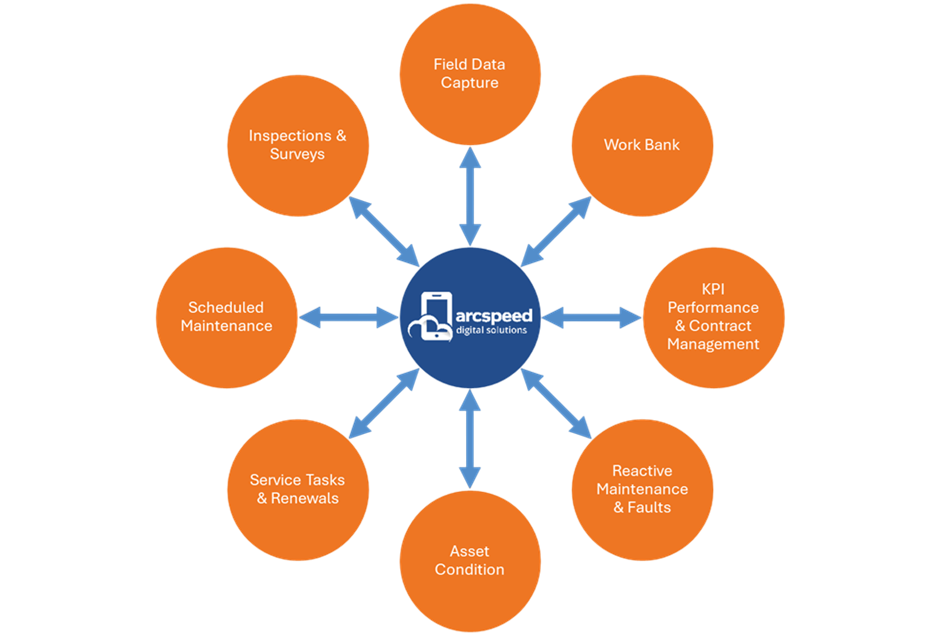
Supporting all aspects of the asset management journey – from asset condition surveys to pre-planned maintenance, fault management and inspections – our platform provides an accessible, scalable and easily customisable way to support organisations of all sizes in effectively managing and maintaining their asset estate.
We’re passionate about using our technology to solve “real world” problems, always love a challenge and believe the best way of seeing the benefits of our technology solutions is to try them yourself.
Contact us to discuss how we can help your organisation manage its assets more effectively and arrange a free consultation and demo.
Leave a Reply